
Automotive Generative Engine Optimization – Optimizing Your Content for AI-Powered Search
What is GEO (Generative Engine Optimization)?
Generative Engine Optimization (GEO) is a modern content strategy designed to help your content appear in AI-generated search results—like those from ChatGPT or Google AI Overview. Unlike traditional SEO, which targets rankings on search engine results pages (SERPs), GEO aims to make content accessible and referenceable by AI systems answering user queries for AI search engines and voice assistants.
Better explained – Generative Engine Optimization (GEO) is an emerging approach to content optimization that focuses on improving visibility in AI-powered search results—such as responses generated by tools like ChatGPT, Google AI Overviews, and other conversational or generative search engines.
Unlike traditional SEO, which is designed to help web pages rank on standard search engine results pages (SERPs), GEO aims to ensure your content is discoverable and referenced by AI assistants and generative platforms that pull from web data to deliver direct answers to user queries.
As AI becomes more integrated into how people search for information, GEO is quickly becoming an essential strategy for digital marketers and content creators.
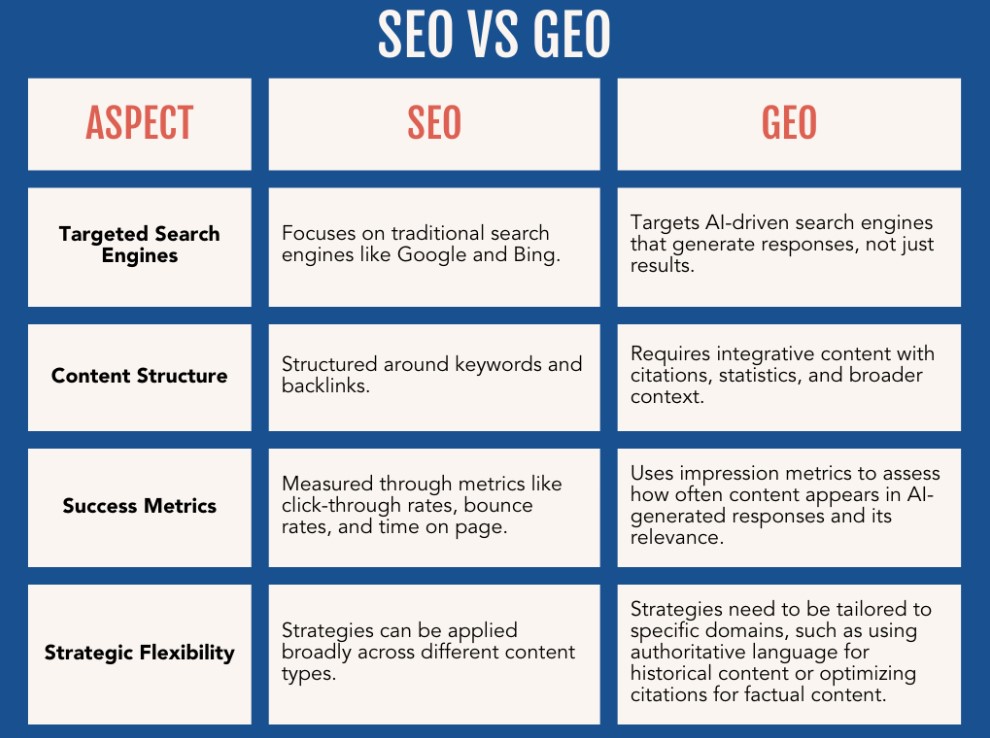
🚀 SEO vs. GEO: What’s the Difference?
| Feature | SEO (Search Engine Optimization) | GEO (Generative Engine Optimization) |
|---|---|---|
| Goal | Rank web pages on traditional search engine results pages (SERPs) | Get content featured in AI-generated answers (e.g., ChatGPT, Google AI Overview) |
| Audience | Users browsing Google, Bing, etc. | Users asking questions through AI-powered interfaces |
| Content Type | Keywords, metadata, structured data, backlinks | Clear, fact-based, conversational, AI-trainable content |
| Search Behavior | Click-through from ranked results | Direct answers pulled from source content by generative AI |
| Ranking Factors | On-page SEO, domain authority, backlinks, technical SEO | Content clarity, topical authority, format structure, and source credibility |
| Optimization Tools | Google Search Console, SEMrush, Ahrefs, Yoast | Schema markup, fact-checking, NLP-aware formatting, LLM testing |
| Example | “Best SUVs under $30K” returns a list of links to car websites | “What are the best SUVs under $30K?” is answered directly in AI overview with cited sources |
A structured comparison graphic breaking down key differences between SEO vs. GEO, highlighting content format and ranking metrics.
How to Implement GEO: Best Practices
- Use natural language questions: Add headers like “What is the best truck for towing?”
- Provide clear, concise answers: Avoid fluff—AI favors direct, well-structured content.
- Use schema markup: Help AI understand your content with structured data.
- Fact-check everything: Accuracy improves your chances of being cited.
- Optimize for topical authority: Create multiple pages around a niche subject.
- Test visibility: Use tools like ChatGPT and Google AI Overview to see how your content appears.
🧠 Final Thoughts
GEO doesn’t replace SEO—it complements it.
As AI search becomes more prevalent, websites that adapt early by optimizing for both human readers and machine-generated summaries will have a clear competitive advantage. And as AI continues to shape how users search and consume information, blending traditional SEO with GEO gives you the best of both worlds. Start optimizing now to stay ahead of the curve in the evolving search landscape.
Please Get in touch today to learn more!
In order to place on AI Search for GEO, Your website will need to support LLMs.txt file placement. Which will define guidelines for AI crawlers; helping ensure your content is properly discovered and represented in AI-powered search experiences, content optimized for AI search engines and voice assistants.
What is a LLMs text File
An LLMs.txt file is a proposed standard for a simple text file that tells Large Language Models (LLMs) how to access and understand the content on a website. It serves as a navigational guide for AI systems, listing key URLs for important documents and content in a structured Markdown format, helping them bypass the inefficient and information-heavy process of crawling HTML pages. The goal is to provide AI models with a clear, concise map to a website’s most relevant information, improving search accuracy and efficiency.
Purpose of an LLMs.txt file
- Improves AI interaction: It helps LLMs quickly find and process core information, reducing the time and resources needed to crawl and understand a website.
- Enhances AI performance: By providing a direct path to relevant content, LLMs.txt helps AI models deliver more accurate and contextually relevant results.
- Future-proofs SEO: As AI-powered search becomes more prevalent, an LLMs.txt file helps websites stay ahead by ensuring their content is easily discoverable and understood by these new tools.
- Provides clarity and structure: It offers a streamlined alternative to HTML, allowing AI to focus on essential content instead of being bogged down by website navigation, ads, and other extraneous elements.
How it works
- Creation: A developer creates the LLMs.txt file using Markdown, a simple text formatting language, to list key content areas with descriptive links.
- Placement: The file is placed in the root directory of the website.
- AI Interaction: When an LLM needs to understand a website, it can fetch the LLMs.txt file to get a prioritized list of relevant documents, similar to how a human might scan a table of contents.
- Content Accessibility: The LLM then uses the URLs in the file to access and process the specific content, such as documentation, blog posts, or product pages.
LLMs.txt vs. other files
- LLMs.txt vs. robots.txt: While
robots.txtcontrols which crawlers can access pages, LLMs.txt guides LLMs to the content that should be indexed and understood. - LLMs.txt vs. sitemap.xml: A sitemap.xml lists all indexable pages for search engines, whereas LLMs.txt provides AI models with a curated, structured view of key content for faster retrieval and analysis.